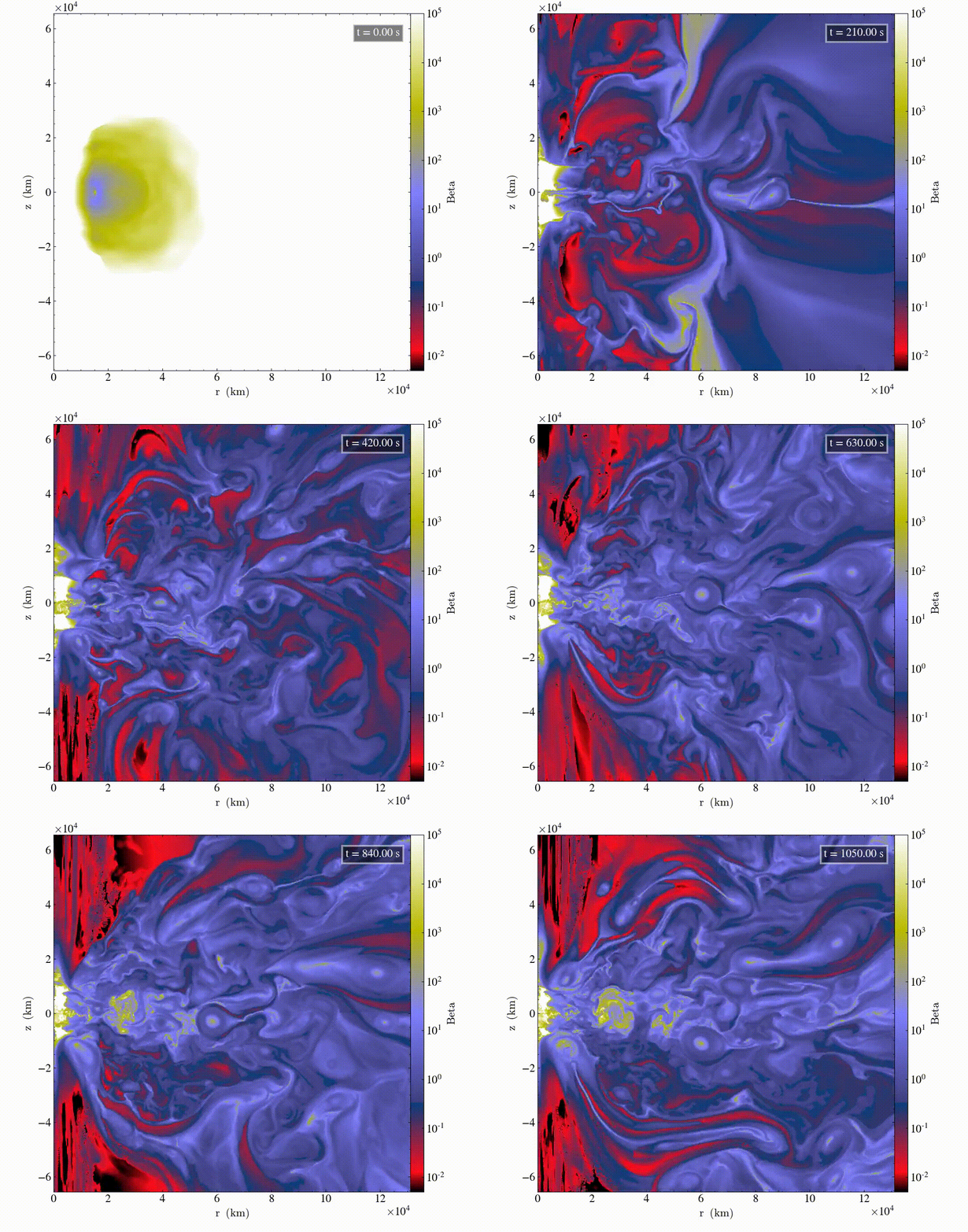
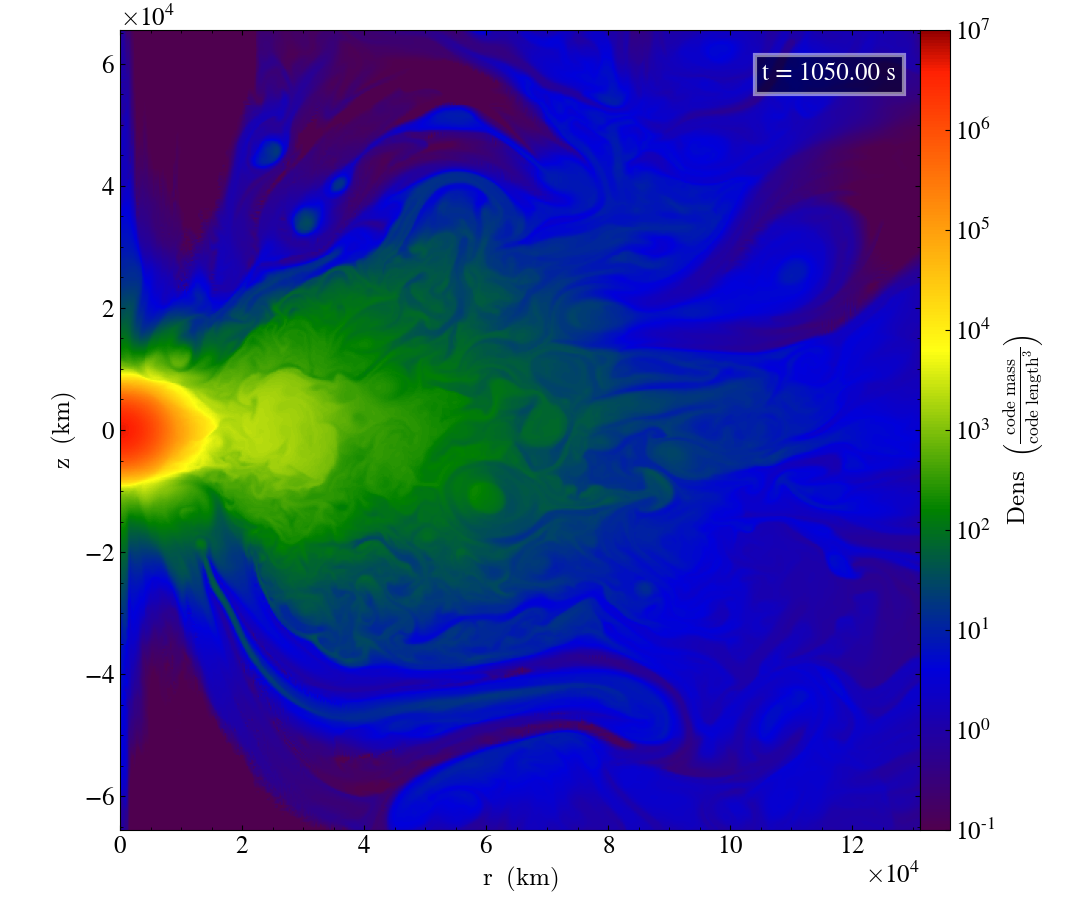
Project Overview
This project involved the application of advanced computational techniques to simulate and analyze complex White Dwarf merger events. Utilizing the Magnetohydrodynamic (MHD) equations, the study extended the understanding of magnetized stellar interactions for precise astronomical modeling.
MHD Formulation and Conservation Laws
The simulation relies on the MHD equations, encompassing the conservation of mass, momentum, energy, and magnetic induction. These equations are expressed as:
\(\frac{\partial \rho}{\partial t} + \nabla \cdot (\rho \mathbf{v}) = 0\) (Conservation of Mass)
\(\frac{\partial \rho \mathbf{v}}{\partial t} + \nabla \cdot (\rho \mathbf{v} \mathbf{v} - \mathbf{B} \mathbf{B}) + \nabla p^* = 0\) (Momentum Conservation)
\(\frac{\partial E}{\partial t} + \nabla \cdot [(E + p^*) \mathbf{v} - \mathbf{B}(\mathbf{v} \cdot \mathbf{B})] = 0\) (Energy Conservation)
\(\frac{\partial \mathbf{B}}{\partial t} = \nabla \times (\mathbf{v} \times \mathbf{B})\) (Magnetic Induction)
Here, \(\rho\) is the density, \(\mathbf{v}\) the velocity, \(\mathbf{B}\) the magnetic field, and \(p^*\) the total pressure including magnetic contributions.
Simulation Methodology
The simulations were conducted using the unsplit staggered mesh MHD solver in FLASH on the STAMPEDE 2 supercomputer. The project leveraged High-Performance Computing (HPC) for detailed analysis, facilitating comparison with traditional hydrodynamic models. This exploration enhances current astronomical understanding, offering novel insights into the intricate dynamics of stellar mergers.